Exhumed recounts the true story of America’s first vampire
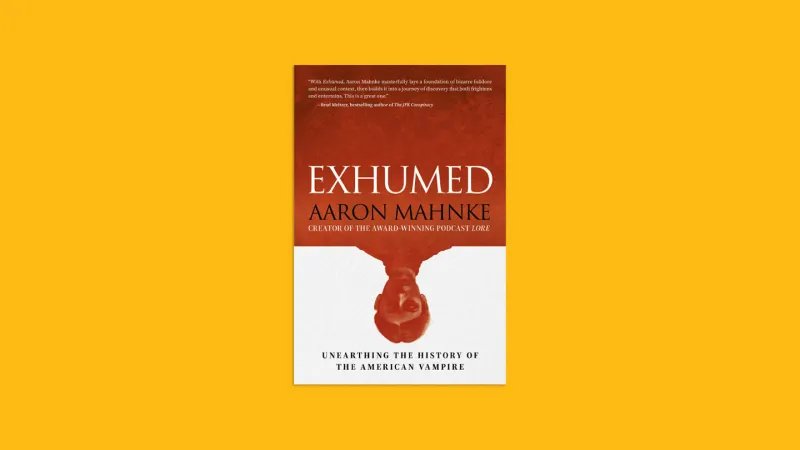

Exhumed
Aaron Mahnke
Running Press, $30.00
October is my favorite month. I love when the leaves change colors and the air gets brisk. My hunger for media that sends a shiver down my spine is at an all-time high. This spooky season, I found satiation in Exhumed, a new book by historian Aaron Mahnke.
Mahnke draws on rich science-based history and folklore to show how fear of the unknown has shaped culture throughout history, even into the present day. He cites Taylor Swift, Twilight and other pop culture phenomena in his analysis — a choice that injects fresh air into the otherwise miasmic atmosphere. And thanks to Mahnke’s gripping prose, I felt like I was in the middle of the action. It was hard to lay the book down.
Exhumed kicks off with the true story of America’s first “vampire.”
Walk with me for a moment back in time to Exeter, Rhode Island in 1892. Rampant tuberculosis is killing scores of people, including three members of the Brown family: matriarch Mary and her daughters, Mary O. and Mercy L. Then a son, Edwin, falls ill with the same symptoms — sparking concern that one of the women is an undead vampire who is sucking his life away. The town exhumes the bodies.
Mercy is surprisingly well-preserved. Her hair and nails appear longer and blood dribbles from her skin when it is pierced, “evidence” that confirms everyone’s worst fear: Mercy is indeed a vampire. (Nevermind that she perished in the dead of winter, when temperatures were probably cold enough to substantially slow decomposition.) The town burns Mercy’s heart, though it doesn’t save poor Edwin. These events helped inspire Bram Stoker’s Dracula, which was published five years later.
Interestingly, the cause of tuberculosis — a bacterium — was discovered a full decade before Mercy’s story unfolded. But news doesn’t always travel fast and entrenched beliefs can be difficult to change, even in the face of hard evidence. Exhumed explores this idea far beyond Mercy’s tragic tale.
Fear has led people to do some extremely odd things by today’s standards: burning hearts to kill “vampires,” setting boobie-traps in graves to prevent the dead from rising or drinking the blood of freshly hanged men to “cure” epilepsy. Without modern science to explain the unexplained, people often filled in the blanks with stories, Mahnke explains.
He implores readers to withhold judgement. After all, storytelling is one of the main ways that humans make sense of the world. “All of us, both then and now, are simply making the best of what we have, trying to find a way to improve our lives,” Mahnke writes.
Perhaps this practice continues today in different shades.
At one point, eating mummies, or “mumia,” was considered cure-all for most ailments , da Vinci believed the human body contained “vital spirits.” When someone died, there’d be leftover spirits for the living to make use of.
Buy Exhumed from Bookshop.org. Science News is a Bookshop.org affiliate and will earn a commission on purchases made from links in this article.