
This Halloween, amateur astronomers may be in for a dwarf planet treat
The outer solar system is yielding its secrets to the Vera C. Rubin Observatory.
Less than five months into the observatory’s decade-long survey of the sky, a potential new dwarf planet has already popped up in its data, astronomers reported this week at a meeting of the American Astronomical Society’s Division of Planetary Sciences in Spokane, Wash.
Another team reported a handful of new Neptune Trojans, icy objects that share an orbit with Neptune, at the meeting and in the Astrophysical Journal Letters. The findings are filling in astronomers’ picture of the Kuiper Belt at the solar system’s frigid fringes.
“It feels a little bit like we’re replicating the 1800s and early 1900s, discovering what the solar system even looks like in general,” says Sam Deen, an amateur astronomer based in Simi Valley, Calif. “We’re finding out what there even is in the first place that makes up most of the Kuiper Belt.”
A possible dwarf planet hid in historical data
Perched on a mountaintop in Chile, the Vera Rubin Observatory is on a mission to map the entire southern sky every couple of nights, searching for faint and fast-moving cosmic objects. The observatory took its first images in June 2025 and officially began a decade-long survey in June 2026.
Even before the official survey started, Rubin had detected the motion of an object orbiting billions of kilometers beyond Pluto. Rubin observed the object 30 times on 20 nights between March 4 and July 11. But no one knew it was there until October 13, when astrophysicist Matt Holman of the Smithsonian Astronomical Observatory in Cambridge, Mass. ran a search for moving dots of light in the data.
The object, called 2026 ED138, appeared to be about 47 times as far from Earth as Earth is from the sun. Its brightness suggests it’s between 600 and 1500 kilometers wide, potentially as large as other dwarf planets like Ceres and Makemake. That’s probably big enough to be spherical, making it a dwarf planet.
“It’s really big. It’s damn huge,” Deen says. “No matter what you call it, it’s still the biggest thing we’ve found in the entire solar system in 19 years.”
When Holman realized what he had found, he was thrilled but doubtful. “It’s quite an exciting thing,” Holman said in a news briefing at the meeting on October 27. “But one of the things that you need to do when you discover something potentially of this size is to try to verify that it’s true.”
Holman and colleagues were able to find observations of the same object in archived data from the Dark Energy Camera, located on an adjacent mountaintop in Chile, taken in 2016.
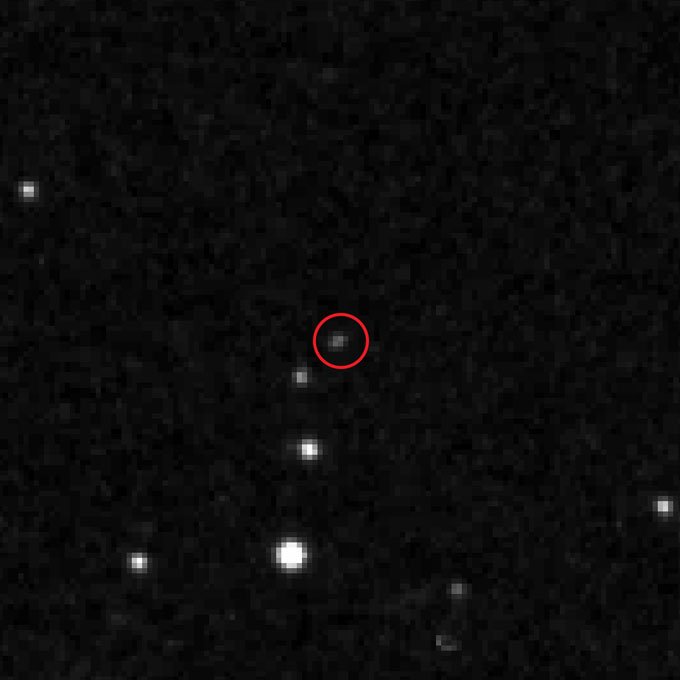
Deen was able to trace it back even farther, to photographic plates taken as part of a sky survey at Palomar Observatory in California in 1954. Other amateur astronomers independently found the same sightings.
“They took an image from Palomar in 1954, and another about half an hour after the first one, that both by pure chance happen to point at where ED138 is,” Deen says. “And it’s really obvious. If you know it’s supposed to be there, it’s not particularly faint.”
So why didn’t anybody notice it until now? It’s partly because ED138 practically crawls across the sky, orbiting the sun once every 280 years. It was also moving against a dense background of Milky Way stars, where it blended in.
By combining observations spanning decades, astronomers can calculate the object’s orbit with more precision.
Deen is hoping to observe the potential new dwarf planet pass in front of a distant star on Halloween. That sort of observation, called an occultation, can help reveal more details of the putative dwarf planet’s size and shape, and even whether it has moons or rings. Usually, it takes years to understand an object’s orbit well enough to predict an occultation, Deen says. “Getting to do it immediately is like being a kid in a candy shop, really.”
-

Once they knew where to look, amateur astronomers started finding the new dwarf planet in decades-old telescope images. This one is from the Palomar Telescope in 1954. ED138 is the faint dot in the middle (red circle), moving slightly from left to right between the two images. Caltech, Space Telescope Science Institute
Icy objects could offer clues to solar system beginnings
A crop of newly spotted Neptune Trojans were masked by the Milky Way, too. These asteroids gather in the same orbit as Neptune, but offset from the planet at 60 degrees. Astronomers think they were some of the original building blocks of the solar system and contain an ancient record of planetary formation and evolution.
Other planets have Trojans, too. Jupiter has thousands. Astronomers think Neptune has many more, but so far they have seen only 30 in the cluster of space objects that orbit ahead of Neptune, and just two in the cluster behind it.
“We would expect these [groups of Trojans] to be symmetric in numbers, so you have to get more than two,” planetary scientist Meg Schwamb said in a news conference at the meeting on October 28.
The trailing cloud happened to have been moving in front of the Milky Way from the perspective of Earth for the last 15 years. Spotting individual Trojans against that crowded background was “like finding a needle in a sequined dress,” said Schwamb, of Queens University Belfast in Northern Ireland.
Schwamb and colleagues examined Vera Rubin data taken from the commissioning phase — the period when engineers were testing the telescope. In this early data haul, the team found two more trailing Trojans, plus one candidate. They seem to be similar in composition to the leading ones, which matches theories of how the solar system formed.
“It just kind of got lucky,” Schwamb said. “These objects photobombed the commissioning survey.”
“This is really the appetizer for what Rubin Observatory is going to do in its mission for the next ten years,” she added. “There’s hundreds more of these objects likely to be found.”
Some of the excitement about these discoveries is dampened by fears of losing observations to bright satellites crisscrossing the telescope’s field of view, says astronomer Sam Lawler of the University of Regina in Canada.
“I have to put in the constant downer of how the increasing numbers of satellites will make these discoveries harder,” Lawler says. “There are one hundred new satellites launching every week, and they keep getting bigger and brighter. These discoveries will be hindered by that.”
But even with the satellites, Lawler anticipates many more cool discoveries from Rubin.
“Just finding a dwarf planet so quickly, maybe we’ll find something even bigger,” she says. “There could be something the size of Mars out there. And then we’d have the whole planet debate all over again. It would be fun.”